
The U.S. Coast Guard has decided to cancel the planned high-latitude mission of the icebreaker Healy, which means they will rely more on their newest icebreaker as the Arctic season becomes more active.
Healy has been docked in Seattle since it experienced a serious mechanical failure during sea trials off the coast of Washington on July 13. According to gCaptain, the Coast Guard has confirmed that the 420-foot icebreaker will not go on its scheduled summer mission in 2026, although they are still assessing if it can participate in other operations.
“The Coast Guard is still investigating the cause of the mechanical failure onboard Coast Guard Cutter (CGC) Healy,” a Coast Guard spokesperson told gCaptain. “CGC Healy will not complete its planned 2026 high-latitude summer mission. However, we are working on repair plans and looking into the possibility of additional operations.”
So far, the Coast Guard has not publicly shared what caused the failure or how long repairs might take. A source familiar with the incident mentioned to gCaptain that the issue was linked to an explosion in one of Healy’s diesel engines during sea trials. This incident resulted in Healy being towed back to Seattle, but the Coast Guard has not confirmed this account.
The situation is significant.
China has sent its two research vessels, Xue Long and Xue Long 2, through the Bering Sea this summer. In response, the Coast Guard deployed the National Security Cutter Munro to keep an eye on their movements in U.S. waters and over the extended continental shelf.
Further north, Xue Long conducted 12 ice-station operations above 82 degrees latitude and deployed over 30 ice-based buoys to gather data on sea-ice movement, ocean conditions, and atmospheric changes. Some of these buoys are meant to stay in place even after the ship leaves.
The U.S. and Canada are closely monitoring these operations. The Coast Guard’s Storis and the Royal Canadian Navy’s HMCS Max Bernays have spent weeks observing Xue Long as it carried out its high-Arctic research.
“This summer, CGC Munro was monitoring two Chinese research vessels traveling north through the U.S. Exclusive Economic Zone and over the U.S. Extended Continental Shelf in the Bering Sea,” stated the Coast Guard.
International law allows foreign vessels to pass through the U.S. EEZ, but any marine scientific research in that area or on the U.S. extended continental shelf requires prior U.S. authorization and the sharing of collected scientific data.
Healy’s Long Arctic Record
Commissioned in 1999, Healy has spent over 20 years supporting scientific research and U.S. operations in some of the most remote areas of the Arctic Ocean.
In September 2022, Healy reached the North Pole for the third time since it began service, marking only the second occasion when a U.S. surface ship reached 90 degrees north without assistance. The first such journey was made by Healy in 2015.
That mission included 34 scientists and technicians alongside nearly 100 Coast Guard personnel. Earlier in the patrol, Healy operated in the Beaufort and Chukchi Seas as part of the Office of Naval Research’s Arctic Mobile Observing System program, deploying underwater sensors, sea gliders, and acoustic buoys to study conditions in marginal and pack ice zones.
The North Pole transit provided scientists access to parts of the western central Arctic that are rarely sampled, while the Coast Guard maintained a presence and patrolled near the maritime boundary with Russia.
By 2025, Healy was also taking on a more visible role in the Arctic.
During a 129-day Arctic patrol covering over 20,000 miles, the cutter supported Mission Arctic West Summer and Operation Frontier Sentinel while monitoring foreign research vessels operating in the U.S. extended continental shelf and U.S. exclusive economic zone.
This included monitoring the Chinese-flagged JIDI and Liberia-flagged, Chinese-operated Zhong Shan Da Xue Ji Di north of Utqiagvik.
This patrol also involved scientific work across the U.S. Arctic, East Siberian Sea, and Laptev Sea, with a diversion to help Western Alaska communities affected by severe storms.
In September 2025, the Coast Guard sent Healy back to monitor Chinese research vessels north of Alaska, supported by an HC-130J aircraft from Air Station Kodiak, while five Chinese-affiliated research vessels were operating throughout the Arctic.
The cutter has faced multiple mechanical issues. A fire in the propulsion motor led to the cancellation of its 2020 Arctic deployment, while another engine-room fire shortened its 2024 summer patrol. After repairs in Seattle, Healy returned to Arctic operations that fall.
Storis Takes on a Bigger Role
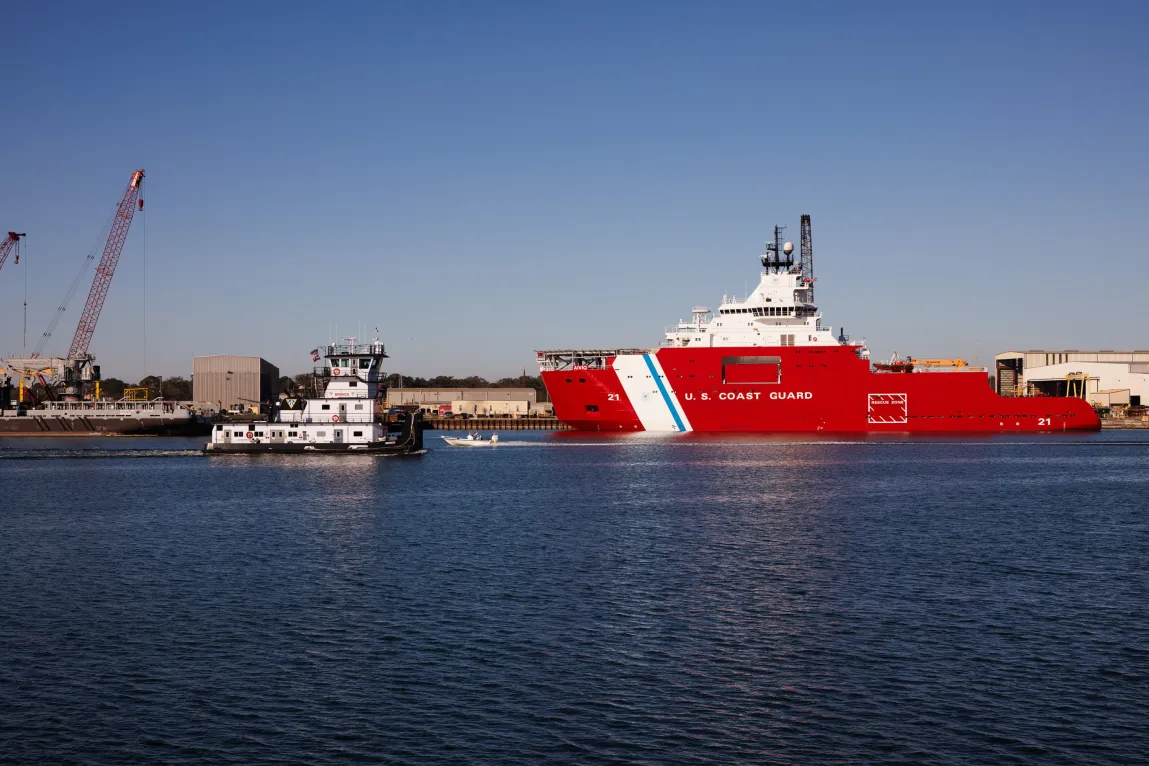
With Healy sidelined, the Coast Guard has relied more on Storis, a commercial icebreaker acquired by the service and commissioned in 2025.
This summer, Storis operated around Alaska and the Arctic, including monitoring operations alongside HMCS Max Bernays as Xue Long passed through the Bering Strait and Beaufort Sea. AIS data indicated that the American and Canadian ships sometimes operated just a few nautical miles from the Chinese vessel.
However, Storis is still a temporary solution while the United States works on a new generation of purpose-built icebreakers.
Construction of the first Arctic Security Cutter started in Finland in June, with the first new cutter expected to be ready in 2028.
Progress is also being made on the first Polar Security Cutter, Polar Sentinel, at Bollinger Mississippi Shipbuilding. However, the heavy icebreaker program is running behind schedule, with a recent government report projecting the first vessel’s delivery in March 2033.
Until these new vessels are in service, the Coast Guard relies on a small polar fleet that includes Healy, the 50-year-old heavy icebreaker Polar Star, and Storis.
This makes Healy’s latest mechanical failure quite significant. The Coast Guard has temporarily lost a vessel that has reached the North Pole three times, supported Arctic scientific research, patrolled near Russian waters, and monitored Chinese activities north of Alaska.
For now, the Coast Guard is working on repair plans and exploring if Healy can participate in additional operations later this year.