
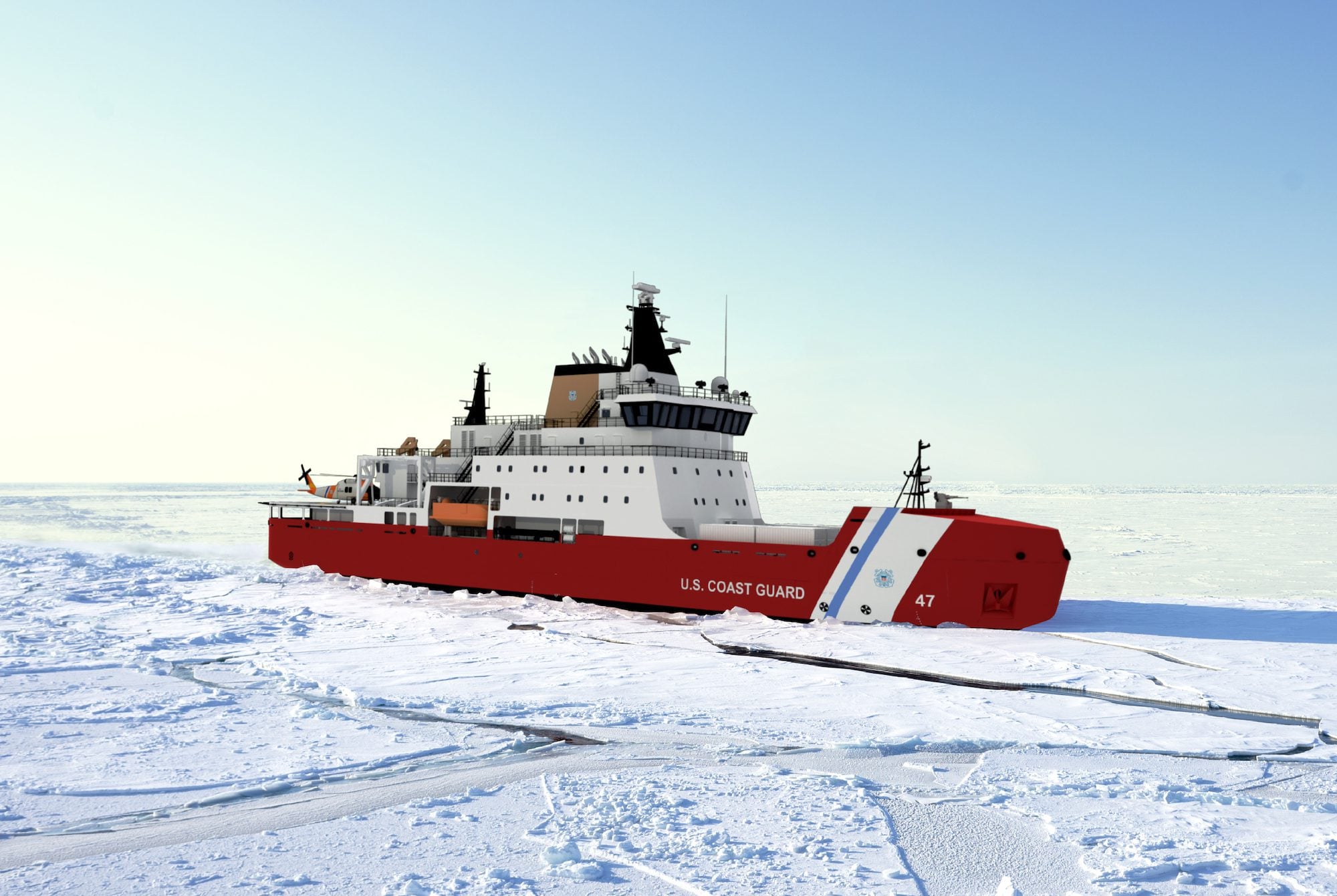
The United States has signed contracts totaling $3.3 billion for six new Arctic Security Cutters (ASCs). This marks the completion of the procurement process for the Coast Guard’s first new medium icebreaker fleet in many years, with construction of the first ship having quietly started back in April.
On Wednesday, the Department of Homeland Security announced a $2.2 billion deal with Bollinger Shipyards for four Polar Class 4 Arctic Security Cutters, along with a $1.1 billion agreement with Finland’s Rauma Marine Constructions for two similar ships. All six vessels are expected to be delivered by the end of 2031, with the first Finnish-built cutter set to arrive in 2028 and the first U.S.-built one in 2029.
These contracts complete the first phase of the Coast Guard’s plan for an eventual fleet of 11 Arctic Security Cutters. This follows a separate $3.5 billion contract awarded in May to Davie Defense and Helsinki Shipyard for five larger Polar Class 3 vessels, which are expected to be delivered by 2035. Construction of the first icebreaker from Davie began last week at Sata Shipbuilding’s facility in Pori, Finland.
Homeland Security Secretary Markwayne Mullin stated, “America’s future in the Arctic demands strength, capability, and resolve. These cutters will provide the operational capability our nation needs to defend our sovereignty, deter adversaries, and protect important resources for the American people.”
Adm. Kevin Lunday, the commandant of the Coast Guard, emphasized that finalizing these contracts is a significant step to ensure American security in the Arctic. “The Arctic Security Cutters will provide crucial capabilities to maintain U.S. sovereignty against aggressive economic and military actions by adversaries,” he said.
The new contracts suggest an average cost of about $550 million per vessel for the Bollinger and Rauma ships. In contrast, the Davie contract averages around $700 million per vessel, as those cutters will be built to the more demanding Polar Class 3 standard, which allows them to operate in tougher ice conditions.
When compared to other international icebreaker programs, Sweden’s new Polar Class 4 icebreaker from HD Hyundai Heavy Industries is priced at about $349 million, while South Korea’s upcoming polar research icebreaker is expected to cost around $220 million. Although direct comparisons can be tricky due to differences in missions and requirements, these figures highlight the investment in the Coast Guard's new Arctic fleet.
In a related report, USNI News noted that Bollinger had already started cutting steel for the first U.S.-built Arctic Security Cutter back in April, before the final contract was announced. This early work shows Bollinger's commitment to speeding up the program and enhancing America’s icebreaker capability.
“It’s all hands on deck,” Bollinger president Ben Bordelon told USNI News. “The White House has directed us to keep the schedule on track and avoid unnecessary changes.”
The Bollinger and Rauma vessels will be based on a design developed by Canada’s Seaspan Shipyards and Finland’s Railotech, while Davie’s cutters will use their fourth-generation Multi-Purpose Polar Support Ship design.
Finland will construct four of the first six cutters, after which production will shift to U.S. shipyards as part of the Icebreaker Collaboration Effort (ICE Pact) involving the U.S., Finland, and Canada.
Once completed, the 11 Arctic Security Cutters will represent the largest modernization of the U.S. Coast Guard's icebreaker fleet. This effort aims to close a long-standing capability gap with Russia while addressing increasing Chinese activities and commercial interests in the Arctic. The first cutters are anticipated to be based in Alaska starting in 2028.