
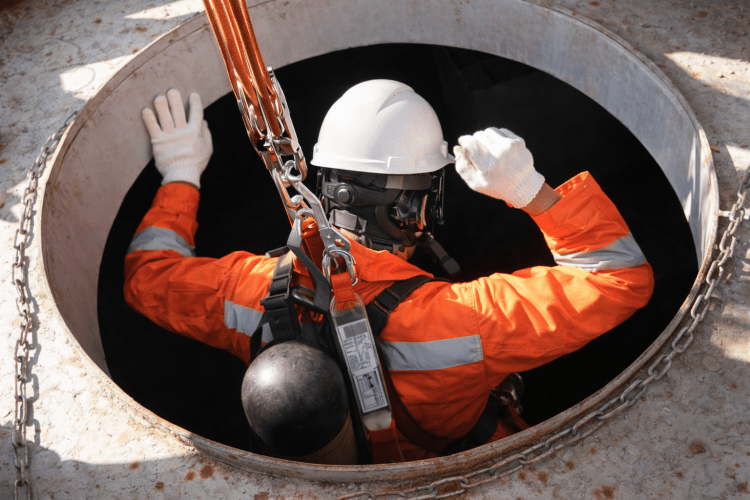
Tragic Accident Highlights Ongoing Risks of Enclosed Spaces
Two crew members lost their lives, and two others were hospitalized after a confined space incident on a freight barge near Ketchikan, Alaska. This incident serves as a stark reminder that enclosed spaces are still one of the most dangerous risks in the shipping industry.
The U.S. Coast Guard is looking into the matter, which took place on Sunday aboard the barge Waynehoe, around 25 miles northwest of Ketchikan.
Four crew members were involved, with Ben Fowler and Sidney Mohorovich confirmed dead. The other two crew members were rescued and are currently in stable condition.
The Coast Guard reported that around 9:14 a.m., watchstanders in Southeast Alaska's Sector in Juneau received a mayday call from the tug Chukchi Sea. It was stated that they had lost contact with four crew members who were inside a confined space aboard the barge while it was docked near Skowl Arm.
A 45-foot Response Boat-Medium crew from Coast Guard Station Ketchikan was sent to the scene, along with personnel from the South Tongass Volunteer Fire Department. Before they arrived, the crew of the tug managed to recover one deceased crew member and helped two others escape from the confined space.
Later, the barge was towed to a pier in Ketchikan to aid recovery efforts. In a coordinated effort among multiple agencies, the second deceased crew member was retrieved from the space on Tuesday.
“We extend our deepest sympathies to the families and colleagues of those affected by this heartbreaking incident,” said Capt. Stanley Fields, Commander of Sector Southeast Alaska. “This incident is a painful reminder that confined spaces on ships can harbor extremely dangerous and unseen risks. The Coast Guard is dedicated to conducting a thorough investigation to determine what occurred and to prevent such tragedies in the future.”
A Persistent and Dangerous Issue
This incident occurred despite stronger safety regulations put in place by the International Maritime Organization (IMO) to prevent fatalities in enclosed spaces—an issue that has been challenging for the industry to tackle for many years.
Data from InterManager reveals that accidents in confined spaces are still quite common. Just in 2023, there were 14 incidents resulting in 34 fatalities—almost double the number from the previous year. Overall, the number of accidents in enclosed spaces has not seen a meaningful reduction since the late 1990s.
“These risks are not new, yet people continue to lose their lives,” said Capt. Kuba Szymanski, Secretary General of InterManager, who recently called for more participation in a global safety survey. “We need to better understand what is really happening on board.”
Bulk carriers make up about 41% of enclosed-space accidents, with most fatalities occurring in cargo holds and access areas. Oxygen depletion, often caused by cargo activities or insufficient ventilation, remains the main cause of death, often worsened by incomplete risk assessments or procedural failures.
New Regulations, Persistent Risks
Over the past decade, the IMO has increasingly tightened its regulations. Since 2015, ships have been required to conduct regular drills for entering enclosed spaces, and since 2016, they must have portable atmosphere testing equipment.
New amendments introduced in 2024 require improved training, ship-specific registers for enclosed spaces, better hazard identification, and stricter rescue planning. These rules also stress the importance of crews following established rescue procedures and avoiding entry into confined spaces without proper safeguards—especially during emergencies.
Even with these precautions in place, incidents like the one in Alaska underline the gap between regulatory standards and actual practices. The investigation into the cause of the Ketchikan incident is still ongoing.