
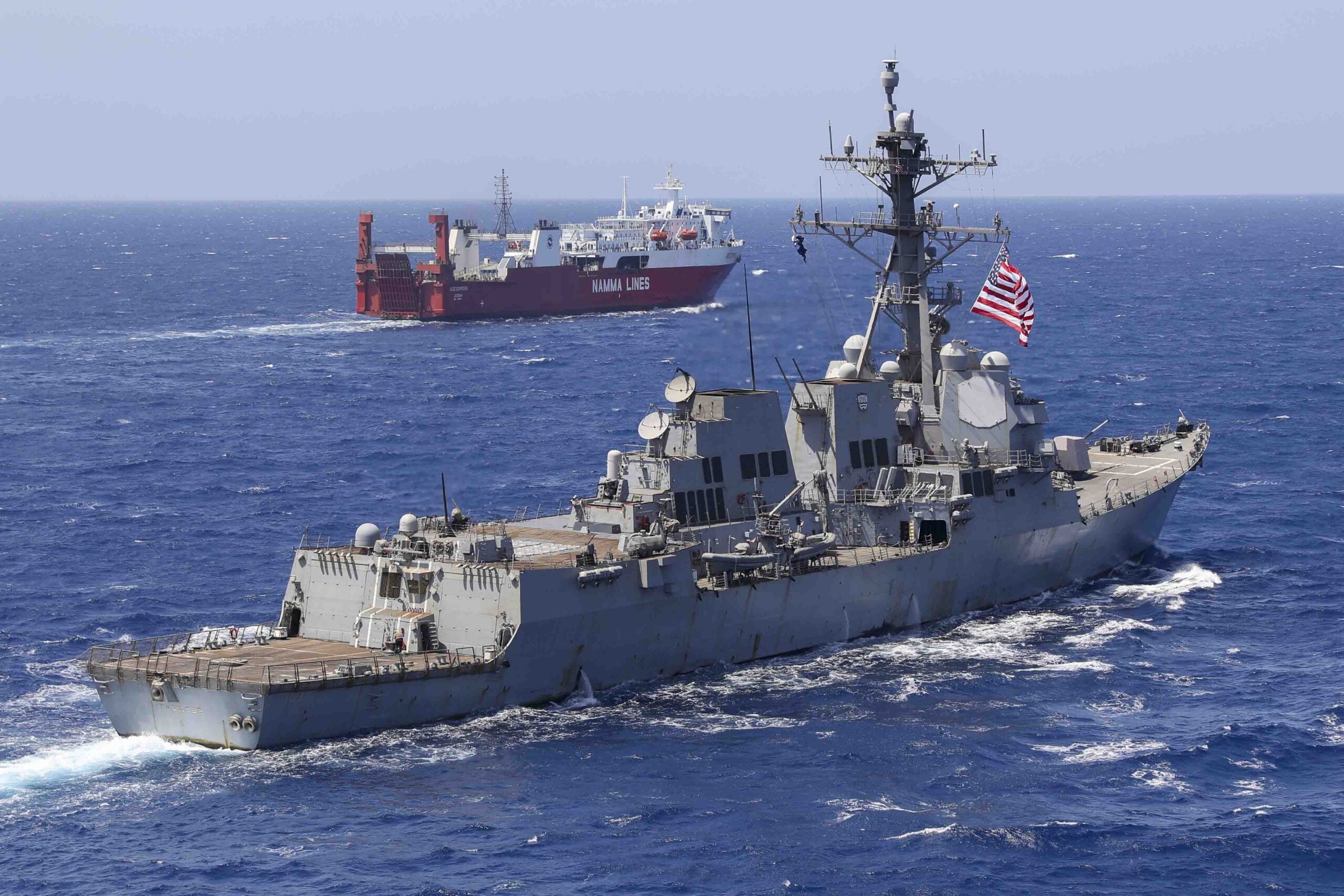
By Captain John Konrad (Opinion) – The Strait of Hormuz is just 21 miles wide, with two shipping lanes each two miles wide and a two-mile buffer between them. There are no alternatives; the pipelines from Saudi Arabia and the UAE combined can handle only about five million barrels a day. This creates a significant issue that isn’t caused by politics but by the geography and hydrology of the area.
While analysts on television focus on the presence of minesweepers and aircraft carriers, they are missing the key issue. The main concern in reopening the Strait of Hormuz is not just about mines or insurance. It's whether the U.S. Navy is willing and capable of reopening it.
Current discussions imply that the White House and Navy are trying hard to reopen the strait, but progress seems slow. A recent post on Truth Social raises the possibility that we might need to reconsider our assumptions.
“What if we 'finishing off' what’s left of the Iranian Terror State, and let the countries that use it, not us, take responsibility for the Strait?” President Trump posted this morning. “That would certainly get our non-responsive 'Allies' moving quickly!”
Let’s unpack this..
— John ? Konrad V (@johnkonrad) March 18, 2026
What if the White House has no intention of reopening the Strait of Hormuz?
What if this war is really about ships & tariffs?
I had a long discussion with a senior DOE official yesterday on background. I can’t share any details but it’s clear everyone’s… https://t.co/DCP0uw7C4E
This raises an important question: Does the White House really intend to reopen the Strait of Hormuz?
The Insurance Kill Switch
When seven P&I clubs from the International Group issued 72-hour cancellation notices for war risk coverage in the Persian Gulf on March 5, they didn’t just raise costs; they made shipping through the area impossible.
These P&I clubs cover about 90% of the world's ocean-going cargo. Without their insurance, ships can't operate. Port authorities won't allow them to dock, banks refuse to finance their cargo, and charterers won't book them. The whole shipping system, from the loading port to the discharge terminal, relies on contracts initiated by clubs in London, Oslo, or Tokyo. When they withdrew war risk coverage, this entire network broke down—not just for a few ships but for the whole global fleet.
War risk premiums soared from 0.25% to 1% of the ship's hull value, to be renewed every week. Charter rates for Very Large Crude Carriers (VLCCs) skyrocketed to nearly $800,000 each day. Over 1,000 ships are now stuck in the Persian Gulf, incurring high charter costs with no routes available. By March 3, only four ships had crossed the Strait, a steep drop from a weekly average of seventy-seven.
Then Trump took a step that few in the media fully understood.
He directed the U.S. International Development Finance Corporation to set up a $20 billion maritime reinsurance facility, with Chubb as the main underwriter, positioning the U.S. government as the last resort insurer for Gulf shipping. A nation took a stand as the backstop for war risk insurance at one of the most critical maritime chokepoints in the world. This facility, working with U.S. Central Command and the Treasury, offers coverage for hull, machinery, and cargo on an ongoing basis to eligible vessels.
Now, the United States has the control switch for the Strait of Hormuz—not by sheer military might, but via insurance.
Pay attention to the latest MARAD advisory: U.S.-flagged, owned, or crewed commercial vessels operating in these waters should maintain a distance of at least 30 nautical miles from U.S. military vessels.
And focus again on this part of the DFC announcement… “coordinated with U.S. Central Command.”
These vessels cannot proceed without the Navy's approval.
So far, that green light has not been given.
The Maritime Dream Team That Was
To grasp the significance of this situation, we must recognize what Trump had built and what has since crumbled.
Trump entered his second term eager to restore American maritime power. He gathered some of the brightest minds in maritime affairs in key government roles since Nixon’s era. He appointed Mike Waltz, the creator of the SHIPS for America Act, as head of the National Security Council. He launched a Maritime Office in the White House. Advocates for maritime interests were placed in significant positions throughout the administration. He signed an extensive Maritime Executive Order in April 2025, initiating a Maritime Action Plan across Defense, State, Transportation, and Homeland Security.
He started concentrating on chokepoints: Panama, the Red Sea, the Suez Canal, and the Greenland-UK Gap. He initiated investigations into Gibraltar and Spain. He initiated USTR actions to place tariffs on Chinese-owned and operated ships. He even invited CMA CGM’s CEO Rodolphe Saadé to the Oval Office, securing a $20 billion commitment for American maritime investment.
The goals were ambitious.
The resistance, however, was also substantial.
Shipowners protested outside USTR against the China shipping tariffs. Nearly every economist stood against the maritime tariff proposals. The entire U.S. tech sector sought concessions from China, which in return desired a pause in USTR actions.
Then came Signalgate. The media leaked a private conversation about military actions against the Houthis and reopening the Red Sea. The operation was derailed. Signalgate forced a reorganization, with Waltz being reassigned to the UN, and the Maritime Office getting downsized. The National Security Council faced severe cuts.
This was the turning point when every maritime initiative began to falter.
What collapsed? Panama failed to honor its promise for free transits for U.S. ships. CMA CGM's $20 billion pledge vanished as the company turned to order vessels from China and India. Congress stalled on the SHIPS Act. The UK traded the Chagos Islands, including Diego Garcia, to Mauritius for a favorable deal, threatening a crucial naval base. Key Navy appointments faced delays or blocks in the Senate.
Then it escalated at the International Maritime Organization in London. In April 2025, sixty-three countries voted in favor of the Net-Zero Framework, a global carbon pricing mechanism affecting ships over 5,000 tons. Trump’s negotiators asked for an exemption for America's small fleet of merchant ships. Europe rejected the request, dismissing American maritime interests as “irrelevant” and adamant that the U.S. lacks leverage.
The U.S. exited the talks. In October, during the adoption vote, Trump labeled it a “Global Green New Scam Tax on Shipping.” Trump took a hard stance, with the State Department warning of sanctions against any country voting yes. Fifty-seven countries opted to delay.
A temporary win. The carbon tax proposal stalled, but the U.S. did not secure exemptions for its ships, and it began to lose ground in the broader conflict for maritime chokepoints and trade against the City of London, Europe, and China.
Then two major setbacks struck in quick succession.
On February 20, the Supreme Court ruled 6-3 that IEEPA does not grant the President authority to impose tariffs, effectively nullifying the “Liberation Day” reciprocal tariffs against China, Canada, and Mexico. An estimated $160 billion in expected tariff revenue disappeared. Trump did impose 15% global tariffs under Section 122, but these are limited to 150 days and require Congressional approval for extension.
His strongest tariff tool was taken away by the courts. Lacking the ability to use tariffs for leverage, he needed a new approach.
And then the Golden Fleet proposal emerged.
In December, Trump announced plans for a new class of Trump-class battleships at Mar-a-Lago: each weighing between 30,000 to 40,000 tons, armed with cutting-edge hypersonic missiles, railguns, laser systems, and nuclear cruise missiles, with plans for twenty to twenty-five vessels. This marked the most ambitious surface combatant program since World War II.
Within 72 hours, every national security think tank, with close ties and funding from NATO nations, mobilized to oppose it. Without thorough assessment, the CSIS published a damaging article titled “The Golden Fleet’s Battleship Will Never Sail,” estimating production costs at $9 billion per hull and predicting cancellation before the first ship could launch. The Foundation for Defense of Democracies criticized it as a waste of resources. Retired admirals on defense boards argued for the Navy to focus on smaller, more distributed platforms instead. Defense analysts rushed to voice their opinions deeming the plan unfeasible.
The same establishment that produced three Zumwalts instead of thirty and thirty nearly useless Littoral Combat Ships instead of none—the same think tanks that presided over the smallest Navy since World War I—quickly explained why America could no longer build substantial ships.
All the while, they had no plan to address the destroyer gap currently undermining convoy operations in the Gulf.
The think tanks provided no alternative plans; they simply offered an attitude of helplessness. This helplessness frames the current developments in Hormuz.
The Leverage Hypothesis
Now, let's connect the dots.
Strike Iran, and Europe could either yield or plunge into an energy crisis.