
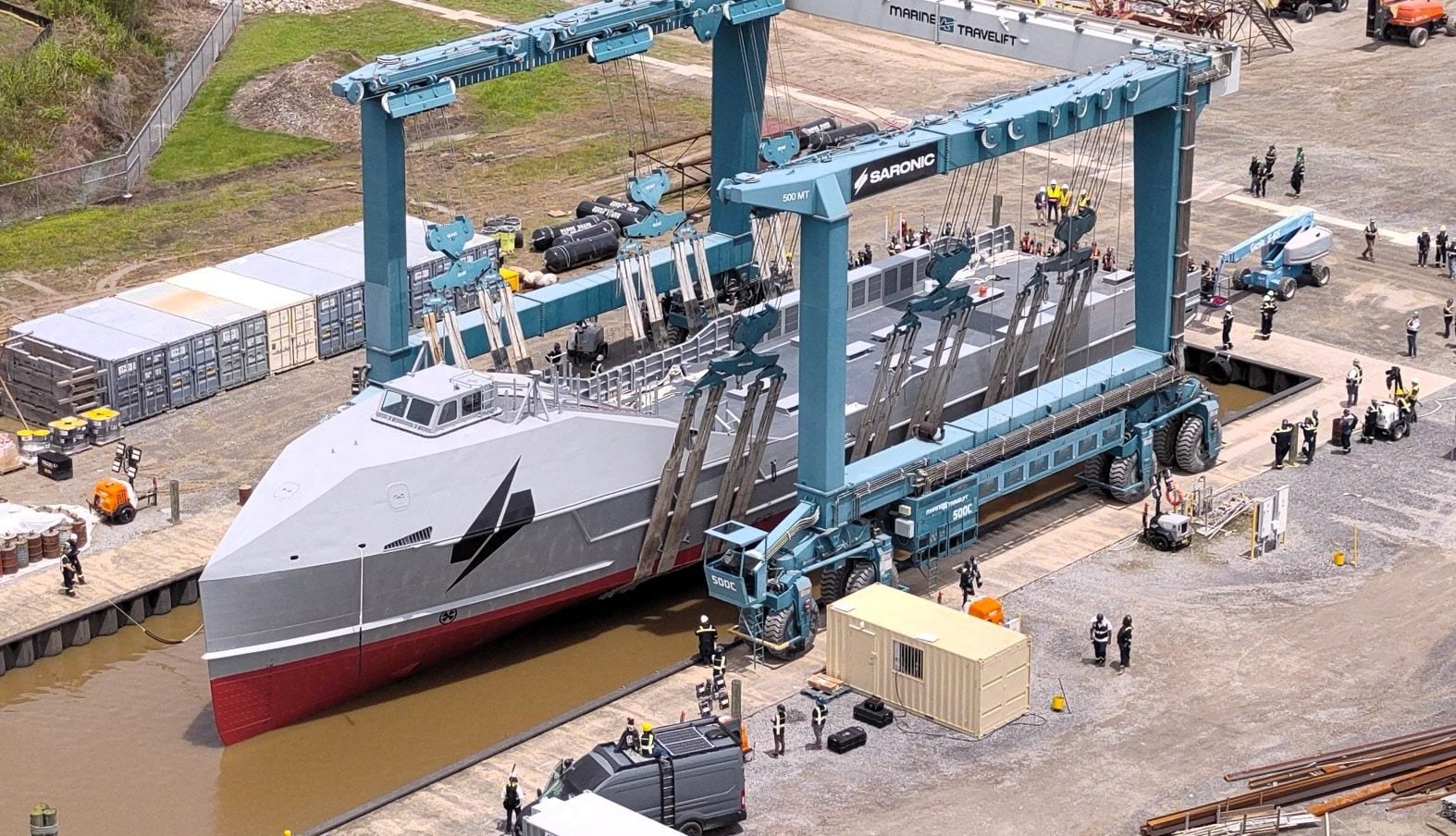
Saronic has introduced its latest autonomous surface vessel called Mirage, which is a 52-foot platform aimed at defense, security, and commercial maritime tasks. This launch adds to the company's rapidly expanding fleet as they ramp up production from their Texas base.
Mirage is positioned between their 24-foot Corsair and 180-foot Marauder vessels. Saronic managed to move Mirage from the initial design phase to actual launch in under a year, and it is now undergoing water trials at their privately funded test site in Galveston, Texas. Additionally, the next vessel is already being built at their headquarters in Austin.
“We launched our first Marauder four weeks ago, and now we're launching another vessel. This pace is exactly what our production model is designed for,” said Dino Mavrookas, co-founder and CEO of Saronic.
The Mirage is a dual-use vessel that can function completely independently or be operated under remote human control through Saronic's Echelon command-and-control system. It boasts a top speed of over 35 knots, a range exceeding 2,500 nautical miles, and a payload capacity of 3,500 pounds, significantly surpassing the range and payload of the Corsair.
This vessel is built for various missions, including maritime domain awareness and security, as well as aerial and surface detection. Like Saronic's other vessels, the Mirage operates using a unified autonomy software system and features an open design to easily incorporate various government and commercial payloads, sensors, and communication technologies without significant changes.
Saronic manufactures the Mirage entirely at its facility in Austin, where its hardware and software development occurs as a cohesive unit. The company claims that this site can produce hundreds of Mirage vessels each year while also handling thousands of Corsair builds.
This launch came just weeks after Saronic revealed its first 180-foot Marauder unmanned surface vessel, reflecting the company’s commitment to quickly expand the production of autonomous ships for military and commercial applications.
Saronic has positioned itself as one of the fastest-growing players in the U.S. maritime autonomy sector. In April, they secured $1.75 billion in Series D funding, reaching a valuation of $9.25 billion to boost their autonomous vessel offerings and domestic shipbuilding capabilities.
The company has also started showcasing its technology in real-world scenarios. Recently, a U.S. Navy-operated Saronic Corsair autonomous vessel successfully rescued two Army aviators after their AH-64 Apache helicopter crashed off the coast of Oman. This rescue is thought to be the first of its kind performed by an unmanned surface vessel. The operation was carried out by the U.S. Naval Forces Central Command's Task Force 59, which focuses on integrating autonomous maritime systems into fleet operations.
This successful mission demonstrated the expanding role of autonomous surface vessels beyond just surveillance and reconnaissance, showing their capabilities in search and rescue, logistics, force protection, and various other maritime missions.