
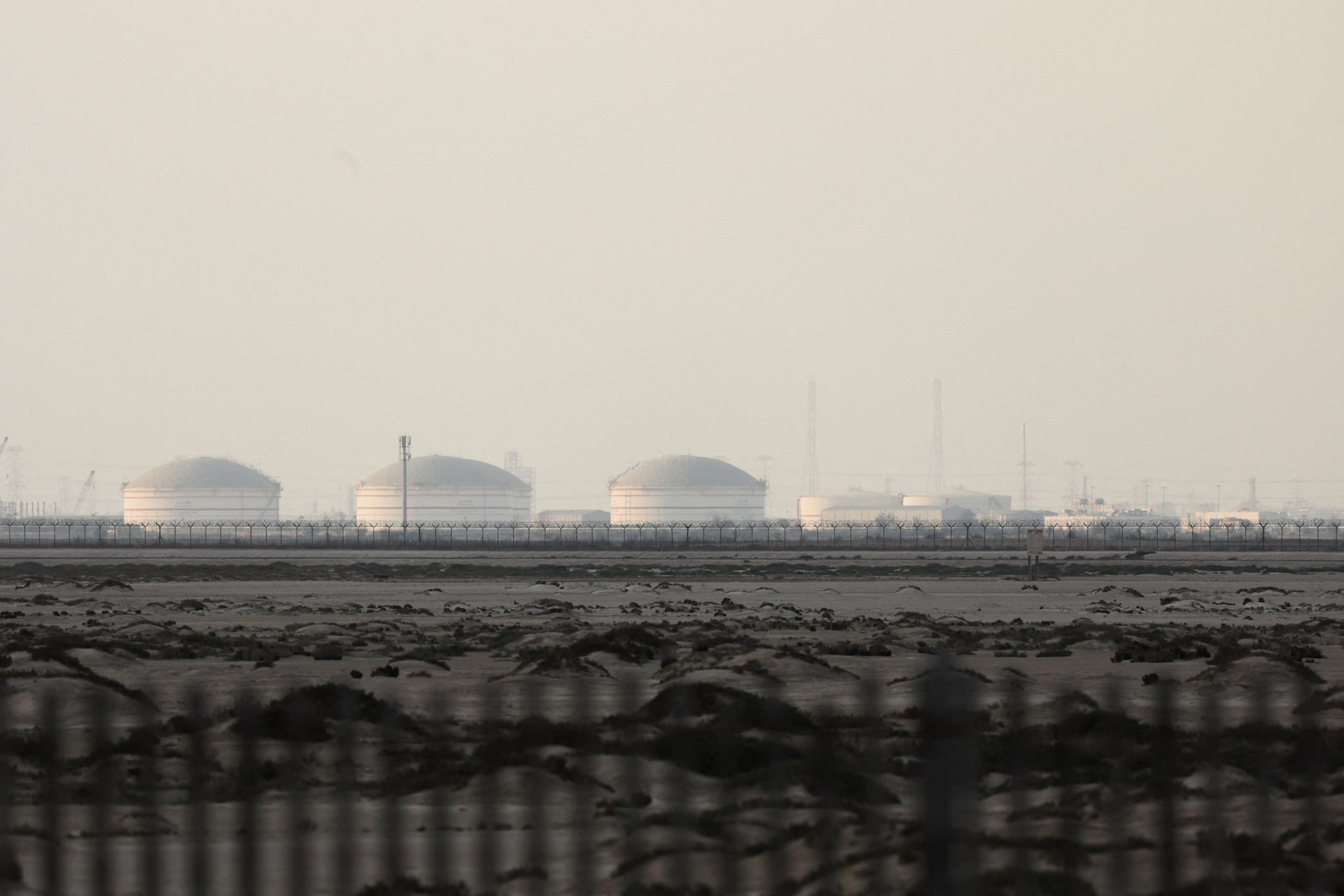
By Ruth Liao and Sherif Tarek (Bloomberg) — A large Qatari complex that hosts the world’s biggest liquefied natural gas (LNG) export plant has suffered significant damage due to a missile strike, just hours after Iran threatened energy facilities across the Persian Gulf.
The Ras Laffan Industrial City was struck by an Iranian missile, while four other missiles were intercepted, according to officials late Wednesday. This site includes the LNG plant, which provides roughly 20% of global supply. Production had already been halted following a drone attack from Iran earlier this month.
MiEntropy’s “Star of the Day” is back once again. This time, attention turns to Qatar, where reports point to fires at the world’s largest gas-to-liquids complex, Shell Pearl GTL, as well as the Ras Laffan condensate refinery operated by QatarEnergy, following suspected Iranian… pic.twitter.com/5LkCIRkF2o
— MizarVision (@MizarVision) March 18, 2026
This incident represents a further escalation in regional hostilities, adding to a series of attacks aimed at oil and gas infrastructure recently. Earlier, crude and natural gas prices increased after Israel targeted Iran’s massive South Pars gas field. Iran responded by warning that several energy sites in Qatar, Saudi Arabia, and the United Arab Emirates could be viewed as “legitimate targets.”
The state-owned QatarEnergy confirmed that all personnel at its LNG facility were safe, as it had been evacuated hours before the strike. Qatar’s interior ministry stated that the fire resulting from the missile attack was under control.
Qatar regards this attack as a serious escalation and a violation of its sovereignty. The Ministry of Foreign Affairs called it a direct threat to national security and regional stability, and later ordered Iranian military and security personnel, as well as their staff, to leave the country within 24 hours.
The Saudi Defense Ministry announced that it had foiled a drone attack on a gas facility in its eastern region. Additionally, debris from a ballistic missile landed near a refinery in south Riyadh.
Brent oil futures climbed after Wednesday’s market close in London, increasing by as much as 8% to $111.90 per barrel.
Statement | Qatar Condemns, Denounces Blatant Iranian Attack on Ras Laffan Industrial City
— Ministry of Foreign Affairs – Qatar (@MofaQatar_EN) March 18, 2026
Doha | March 18, 2026
The State of Qatar expresses its strong condemnation of the Iranian attack targeting Ras Laffan Industrial City, which caused fires… pic.twitter.com/OfQlbrU9jv
The Ras Laffan Industrial City covers 295 square kilometers (114 square miles), which is about one-third of New York City’s size. Besides processing LNG, it also contains other gas-related facilities, including a gas-to-liquids plant, LNG storage, and condensate splitters, as well as an oil refinery.
The attack effectively isolated the site from global markets due to restrictions on tanker traffic through the Strait of Hormuz, following attacks from the US and Israel on Iran. The closure of the Ras Laffan LNG facility prompted Qatargas to declare force majeure on deliveries, disrupting the global LNG market and leading buyers to look for alternative sources.
This disruption has particularly affected Asia and Europe, regions that depend heavily on imported gas for electricity generation. Recent attacks have raised concerns about how long supply will remain affected even after the strait reopens.
“It’s now hard to see Qatari supplies returning to the market before the middle of the year, and even that is a stretch,” said Ira Joseph, a global fellow at the Center on Global Energy Policy at Columbia University.
Shell Plc, which has stakes in some of the gas and LNG infrastructure at Ras Laffan, stated that it is evaluating any potential consequences from the attack.