
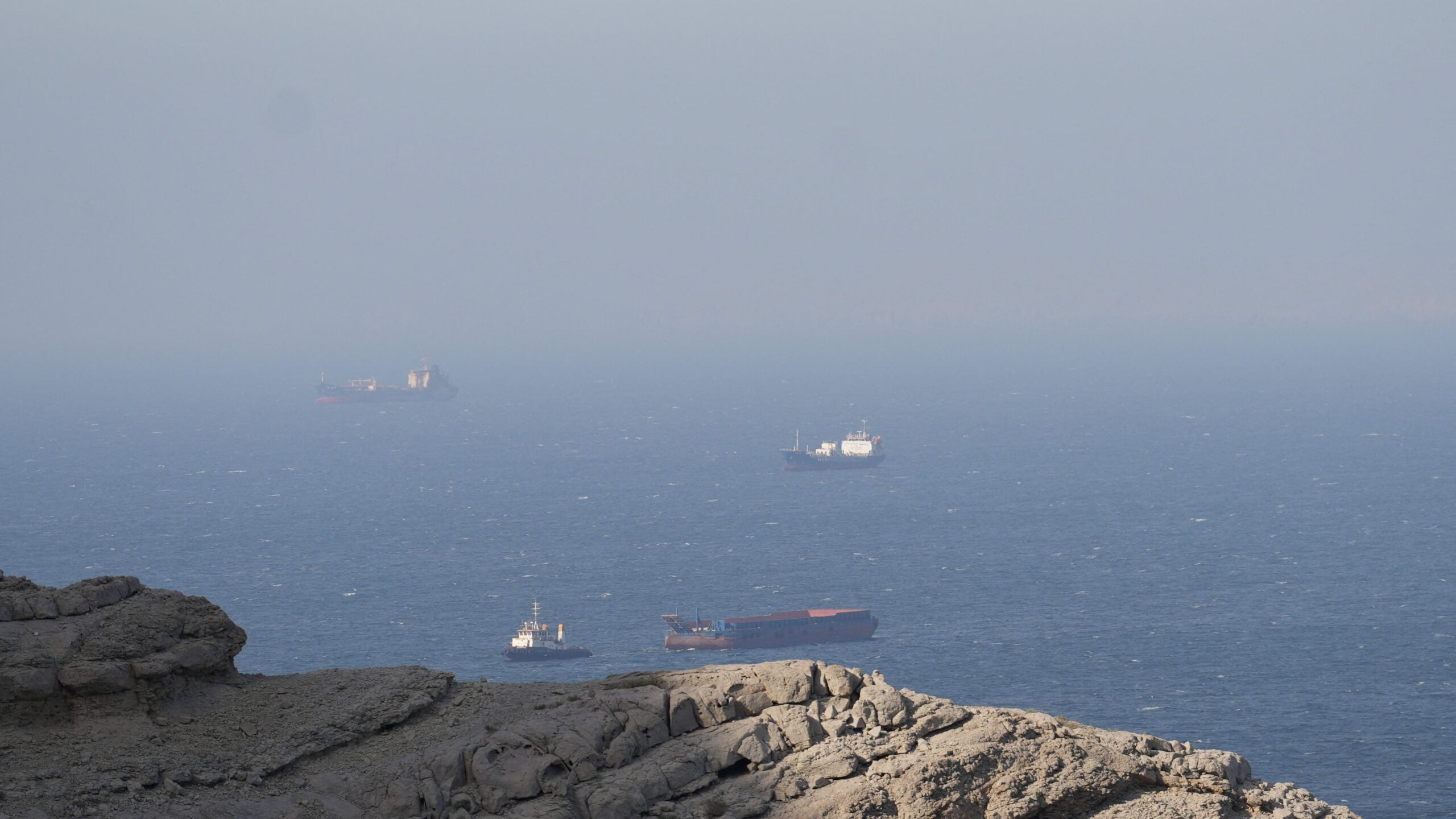
Maritime organizations are asking the Trump administration for clear instructions on how stranded ships can safely exit the Strait of Hormuz.
During a recent webinar hosted by Lloyd's List, Phillip Belcher, Marine Director at INTERTANKO, emphasized that the future of transit through this waterway is uncertain.
Belcher noted, “The latest draft we reviewed is quite similar to what the Iranians released earlier this week. The main route through the Strait of Hormuz, specifically the Traffic Separation Scheme, is currently closed. This is a dangerous situation as there are mines present. Just this morning, we learned there are 80 mines located in that area. It will take time to clear them. While two alternative routes are open, they can't handle the same amount of traffic as the primary channel.”
Before the conflict, the main channel handled about 130 to 140 ships daily. The two alternative routes currently operational do not have the same capacity.
“Our capacity is now limited,” said Belcher. “We are nowhere near the levels we used to have. The U.S. or Omani routes, known as the Southern Route, currently allow about 20 ships a day. The Northern Route accommodates around 10 ships. However, if we can operate around the clock, we could increase that to between 60 and 80 ships per day.”
He described the Southern Route as a kind of breakdown lane for vessels, while the central route in the Strait functions as a major maritime highway.
“We need to reopen that highway to safely manage traffic volumes,” he stated. “A big concern right now is navigational risk, particularly the risk of ships running aground since the Southern Route is close to the rocks, which increases the danger of collisions.”
Belcher also raised concerns about ongoing GPS signal interference, making satellite navigation “completely unreliable.”
“If movement starts to increase as people gain confidence, we could see a large number of ships navigating a small area without proper control,” he warned. “It is essential to ensure that it is safe for them to transit, and these are significant practical concerns.”
The narrowest point of the Strait of Hormuz is 21 miles wide. It's divided into two lanes, each two miles wide—one for incoming traffic and one for outgoing—with a two-mile buffer zone in between. According to the U.S. Energy Information Administration, only a six-mile wide corridor is actively used by commercial and military vessels.
Future Control of the Strait
Belcher expressed concern over the language in the Memorandum of Understanding (MoU) about managing the Strait of Hormuz. Article 5 states that no tolls will be charged for the first 60 days.
“Iran has been given the authority to engage in discussions with Oman and other Gulf states for future management of the Strait,” he explained. “Thus, the agreement effectively makes Iran the sole decision-maker regarding what happens in the Strait going forward, even though Iran is not a part of the UNCLOS framework.”
Belcher expressed hope that Iran will consider adopting the UNCLOS framework, which regulates international maritime activities.
Much like the Strait of Hormuz, transit through the English Channel, Strait of Dover, and Strait of Gibraltar is free of tolls. The Law of the Sea ensures the right to innocent passage through these waters and indicates that a coastal state's territorial waters don't automatically justify tolls.
“No restrictions should be placed on vessels,” Belcher stated.
The maritime industry worries that Iran might declare territorial waters and impose a toll system similar to the one used during the conflict.
“The UN Convention on the Law of the Sea specifies what constitutes territorial waters,” he noted. “This means that Iran could dictate the future arrangements concerning navigation. Clarification on this issue is crucial for maintaining free navigation and avoiding a larger crisis, not just in this region but potentially elsewhere.”
Discussions about monetizing vessel traffic have also arisen in the Strait of Malacca.
Vessel Transits
Tomer Raanan, a Maritime Risk Analyst with Lloyd’s List Intelligence, reported that his team has tracked several vessels leaving the area since the MoU was signed, including those operated by Grimaldi, COSCO, NYK Line, and an Iranian tanker navigating through U.S. blockade routes.
Many recent transits through the Strait of Hormuz have occurred “dark,” meaning they are not transmitting their AIS signals. Kpler noted 10 vessels transited between Sunday and Tuesday, with most not broadcasting their locations.
“The U.S. advises ships using the Omani route to disable all electronic signal transmittals, like radars and AIS,” Belcher added. “Shipowners and seafarers will naturally be cautious, especially after the recent deaths of fourteen innocent merchant seafarers during the conflict.”
A critical question remains about how ships will be prioritized for departure. While there may be pressure to prioritize laden tankers, allowing any country to determine who leaves first is not in line with the principle of freedom of navigation.
“There’s currently no organization capable of managing that level of control,” Belcher remarked. “It might be time to consider assigning some bodies to take on this responsibility soon. We need to resolve this issue promptly.”
Operational Issues
Another significant concern is the seaworthiness of vessels that have been stuck for over 100 days in the warm Gulf waters.
Barnacles and algae growth on ship hulls due to inactivity may reduce their speed and maneuverability, meaning cleaning may be necessary before they can operate normally again.
“This is a genuine operational issue,” Belcher pointed out. “Removing barnacles and algae is essential for ensuring ships can maintain speed. While waiting, shipowners could hire divers to clean the hulls. It would be disastrous if any of those ships were to break down in the narrow passages of Hormuz, reminiscent of the container ship incident blocking the Suez Canal.”
INTERTANKO, along with BIMCO and the NATO Shipping Centre, has released joint transit guidance and security advisories for the Strait of Hormuz, raising concerns over the ambiguous security arrangements moving forward.
Belcher said his organization is keeping a close eye on geopolitical developments, including communications from Washington and Tehran, as well as issues pertaining to Lebanon, which have been frequently mentioned in negotiations.
“We're focused on the geopolitical landscape to ensure we're alerted to any indications of a potential return to conflict, which remains a real possibility,” he said.
Since President Donald Trump announced the agreement, a Memorandum of Understanding has been introduced, but operational details regarding vessel transits are still unclear.
A.P. Moller-Maersk CEO Vincent Clerc stated that the company has not resumed transit through the Strait of Hormuz yet.
In an interview with Euronews, Clerc remarked that clarity on the reopening won't likely emerge for several weeks.
“We don’t yet know where navigation obstacles may arise, especially considering expected shipping volumes and the size of our vessels,” he said.
Jake Scott, COO of Easterly Clear Ocean, added that the peace agreement still has uncertainties, which require shipowners to respond quickly to changing conditions.
“In the short term, we could see a rise in traffic if the ceasefire holds, as the world has been missing vital raw materials,” Scott said. “However, the Iran-U.S. conflict has shown the vulnerability of the global supply chain and highlighted the pivotal role shipping plays in sustaining global economies and societies. If transit levels in the Strait return to what they were before the conflict, commodity buyers may look to diversify their sources, leading to new trade routes. This peace agreement could also fall apart quickly.”