
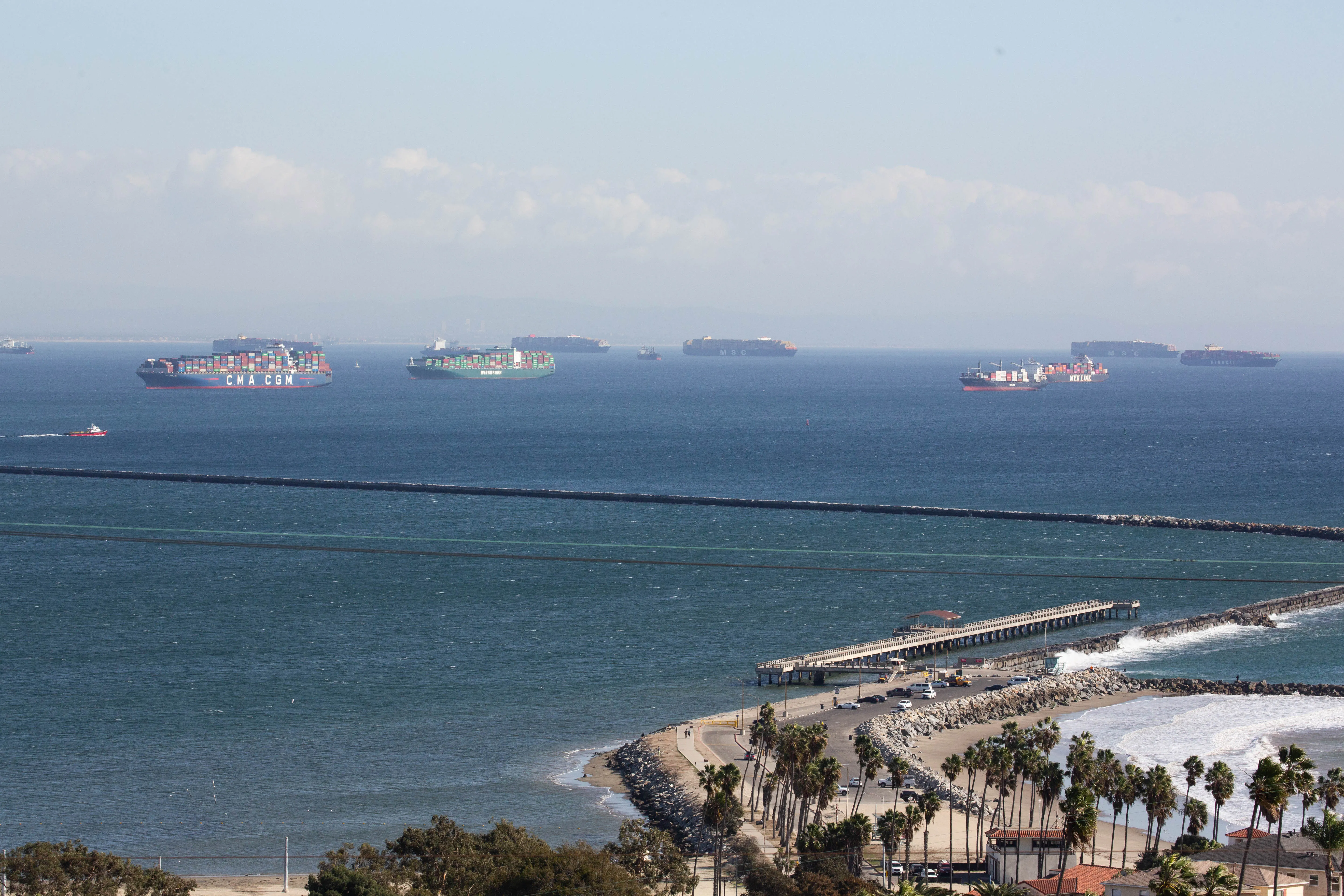
By Lori-Ann LaRocco – The Port of Los Angeles has achieved its best month ever in its history. Port director Gene Seroka shared in a media briefing that the port handled 1,042,652 TEUs, surpassing the previous record from July 2025 by 23,000 TEUs.
This achievement marks the highest volume processed by any port in the Western Hemisphere and is the tenth time the port has moved over half a million loaded imports in a single month, a milestone unique to the U.S.
September also marks the fourth consecutive month of record-breaking volumes for the port, which processed 540,000 loaded TEUs—the largest ever for inbound cargo.
Seroka indicated that the strong volume is largely due to major retailers preparing ahead of potential tariffs. However, he noted that outbound volumes are lower than usual, reflecting ongoing difficulties for American farmers and manufacturers.
A sign of future demand for Asian products can be seen in the number of empty containers processed, which reached 371,000—setting a new monthly record for the port.
“September sets us on a strong path as we approach the last quarter of 2026,” stated Seroka. “These numbers are impressive.”
These strong results contrast with the import slowdown reported by Global Port Tracker and the National Retail Federation (NRF) along with Hackett Associates.
Seroka mentioned that U.S. companies still face short-term challenges in supply chain planning.
“Importers are making quick decisions based on tariffs, costs, and demand,” Seroka said. “For now, orders from Asia are still strong, and our customers are moving their cargo when possible. While November and December may be difficult to predict, we are gaining solid momentum.”
Willy Shih, a professor at Harvard Business School, added that companies are shifting their focus from purely cost optimization to having more flexibility in their supply chains. They are exploring ways to create more options and hedge against tariffs, rather than simply relocating production. This trend has been seen over the past year and a half, but diversification in supply chains is still progressing slowly.
China accounts for around 40% of the cargo volume at the Port of Los Angeles and 60% at the Port of Long Beach.
The U.S.-China trade war has prompted China to shift its manufacturing to Southeast Asia. Both Noel Hacegaba, CEO of the Port of Long Beach, and Seroka cite Vietnam as a prime example of this trend and expect to see another wave of frontloading before the U.S.-China trade truce ends on January 10th.
“While China’s share of our business has decreased from 60% to 40%, we have still been growing as sourcing shifts to Southeast Asia,” Seroka mentioned. “During my upcoming trip to Hong Kong, Guangzhou, and Shanghai, I will be looking at the status of purchase orders, including any cancellations and the steadiness of orders for 90 to 120 days out.”
The upcoming El Niño season is also expected to redirect more containers to the Port of Los Angeles as shipping companies avoid the Panama Canal.
Seroka stated they are preparing for another potential shift in container traffic.
In 2024, during the last significant El Niño event, the port processed 10.3 million TEUs, marking its second-best year in 117 years. Seroka identified four key factors that drove these higher volumes: diversions from the Red Sea, drought-related capacity cuts at the Panama Canal, uncertainty over labor disputes on the East and Gulf Coasts, and frontloading due to tariffs.
“We are witnessing more containers moving to Los Angeles from the Panama Canal,” Seroka stated. “The doubling of vessel fuel prices in the last eight months due to conflicts in the Middle East has also contributed to this shift, as longer journeys consume more fuel at higher costs, which are eventually passed on to importing and exporting companies. Many organizations now prioritize shorter, quicker shipping routes to reach the market.”
Seroka cautioned that rising diesel prices increase the costs of moving goods, which reflects on retail prices.
“Fuel prices at the pump have risen by 36% since late February,” he noted. “All of these expenses are ultimately borne by American families. At a time when the economy is progressing, one has to wonder how much growth could have been achieved without tariffs, trade policies, and rising energy costs. This discussion is far from over. The affordability for American families remains a daily concern.”