
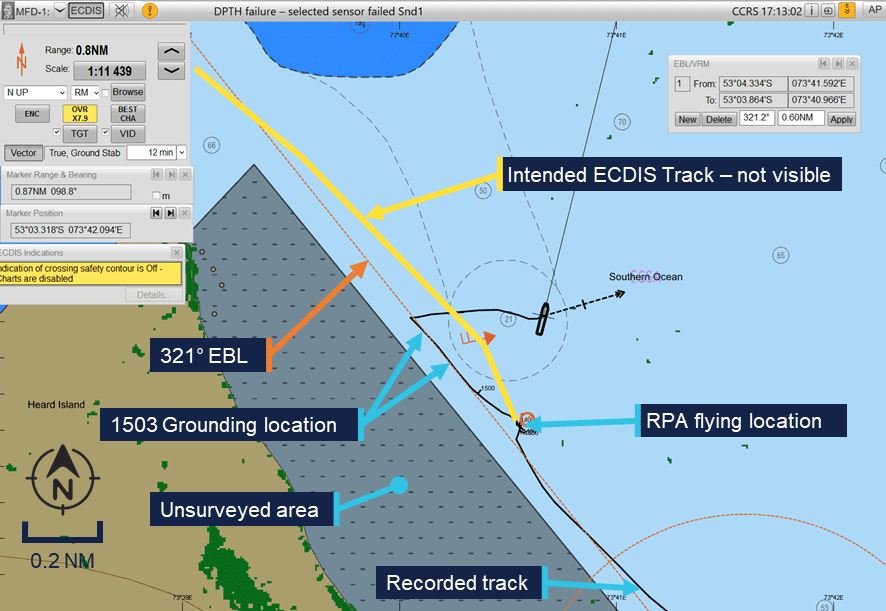
A preliminary report from the Australian Transport Safety Bureau (ATSB) has revealed more details about last year’s incident involving Australia’s Antarctic research icebreaker, RSV Nuyina. It confirms that the ship briefly ran aground near Heard Island, going beyond earlier descriptions that suggested only minor contact with the seabed.
The incident took place on October 13, 2025, while Nuyina was conducting drone surveys near Fur Seal Beach, about 4,000 kilometers southwest of Perth. Initially, the operator, Serco, and the Australian Antarctic Division described the situation as a slight seabed contact without affecting the vessel’s operation.
The ATSB report now provides a clearer timeline, indicating that the ship made contact with both its retractable drop keel and the hull before moving away from the area.
According to ATSB Chief Commissioner Angus Mitchell, the vessel was using its drop keel, which extended about 75 centimeters below its standard 9-meter draft. This keel contained scientific instruments, including a high-resolution multi-beam echo sounder, which was still functioning after conducting overnight seabed mapping.
To prevent interference with the survey equipment, the ship's navigational echo sounders were turned off. Although the multi-beam system continued to collect depth data, this information was not displayed on the vessel's electronic chart display, meaning it was not visible to the crew and couldn't trigger alerts for shallow water.
The grounding occurred while the vessel was moving about five nautical miles northwest after the survey. The captain had planned the route using the rear ECDIS station, but this route was not shown on the forward display used for navigation. While the captain worked on this issue, the second officer continued to navigate using a previously established electronic bearing line from drone operations along the coastline.
This path led the vessel through a narrow channel between a marked bank and an uncharted seabed area, where hydrographic data was lacking.
The acoustics operator monitoring the multi-beam system warned about decreasing depth, noting a depth of about 15 meters, shortly followed by a second alert about rapidly shallowing water. Although the captain ordered the engines to stop and then to move backward slowly, the grounding occurred just moments later.
The drop keel first hit the seabed, followed by the hull. The vessel quickly got free and drifted away from the area before regaining its position.
Most of the damage was limited to the drop keel and its scientific instruments, some of which were either damaged or lost. The hull only experienced minor scraping and paint damage, confirming earlier assessments that the vessel remained seaworthy.
After consulting with authorities and technical experts, Nuyina continued its mission in Antarctica, including a scheduled resupply at Davis Station, before returning to Hobart.
The ATSB pointed out that this preliminary report does not contain any formal conclusions. Investigators have conducted interviews with the crew and reviewed data from the voyage, CCTV footage, operational procedures, and bathymetric information. The final report will address safety factors such as bridge resource management, navigation system integration, and decision-making during operations.
The complete ATSB report can be found here.