
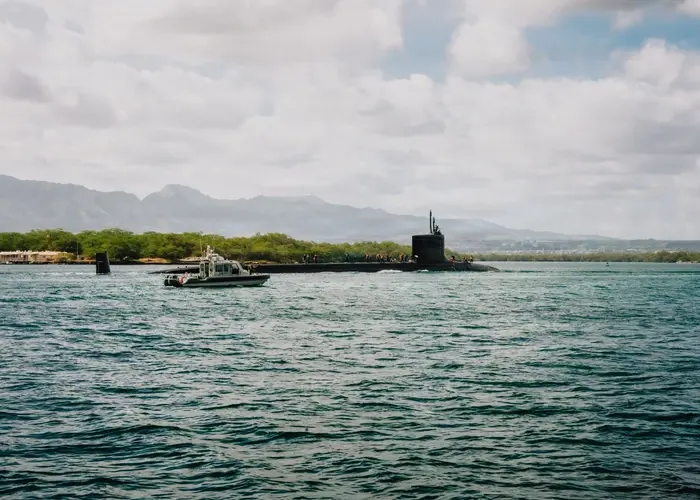
Anduril Industries is set to invest $3.7 billion in a new shipyard in Maryland to produce key components for Virginia-class attack submarines. This project is supported by a U.S. Navy contract worth up to $2.9 billion, as Washington seeks to boost the submarine industrial base, which is currently struggling to meet demand.
The new facility, called Arsenal-2, will be located at Tradepoint Atlantic's Sparrows Point complex in Baltimore County and is expected to start operations in 2030. Anduril says the over 2 million-square-foot facility will create complex components and large assemblies that will be delivered to General Dynamics Electric Boat and HII’s Newport News Shipbuilding, which will handle the final assembly of the submarines.
This project signifies a major move for Anduril into traditional shipbuilding. Although the company is more widely known for its autonomous drones and weapon systems, Arsenal-2 will place it in the supply chain of one of the Navy’s most significant and complex shipbuilding programs.
It is important to note that Anduril will not be constructing entire submarines.
Christian Brose, the company President, stated, “Our goal here is to be a crucial and hopefully, over time, more significant part of the supply chain for our leading shipbuilders,” as reported by USNI News.
According to Anduril, the Navy contract will link payments to actual production outcomes. This, combined with the company's investment, could represent up to $6.6 billion in planned spending on enhancing submarine manufacturing capabilities.
This investment comes as the Navy faces ongoing challenges in Virginia-class submarine production.
Congress usually funds two Virginia-class submarines each year, but actual production numbers have consistently fallen short. A report from the Congressional Research Service noted that production rates have been about 1.1 to 1.4 submarines annually in recent years, hampered by workforce shortages and supply chain issues. The Navy aims to reach two submarines per year, eventually increasing production to approximately 2.33 to meet U.S. fleet needs and commitments to Australia under the AUKUS agreement.
Arsenal-2 is designed to alleviate some of these production limitations by enabling more submarine work to be done concurrently outside the Electric Boat and Newport News facilities.
A senior official from the Trump administration mentioned that the new facility could eventually contribute around 9 million production labor hours each year, which would represent roughly a 15% capacity increase for the Virginia-class program. Anduril intends to manufacture components such as torpedo tubes, which have been identified as key production bottlenecks.
The Baltimore facility will feature high-bay assembly halls, fabrication areas, flexible production lines, and a 1,200-foot graving dock, along with road, rail, and marine connections for transporting large submarine assemblies.
Anduril plans to operate this facility using ArsenalOS, its industrial software platform, to oversee fabrication, material movements, inspections, and other production activities.
Before Arsenal-2 opens, the company will initiate submarine component production at a new 160,000-square-foot facility in Orange County, California. This operation will provide Anduril with roughly a two-year lead time to develop manufacturing techniques and qualify production systems, including work on Virginia-class torpedo tubes.
The Maryland project is expected to create over 3,100 direct jobs and support an additional 11,000 jobs, according to Anduril and state officials.
Sparrows Point was previously home to Bethlehem Steel’s extensive steelmaking and shipbuilding operations and has since been transformed into the Tradepoint Atlantic logistics and industrial complex.
Although Arsenal-2 won't address the Navy's urgent submarine delivery backlog immediately, its planned opening in 2030 coincides with a period when the U.S. will work to maintain higher Virginia-class production while preparing to transfer submarines to Australia under the AUKUS agreement.
This situation is putting pressure on an industrial base that is already finding it challenging to produce enough submarines for the U.S. Navy.
The Virginia-class program has faced delivery delays that stretch over several years, while the Navy and Congress have committed billions to expand shipyards, suppliers, and the skilled workforce needed to ramp up production.
Arsenal-2 represents one of the largest private-sector contributions to this effort so far.